

Match Number One
Belgrade, January 1947, and the beginning of a long count

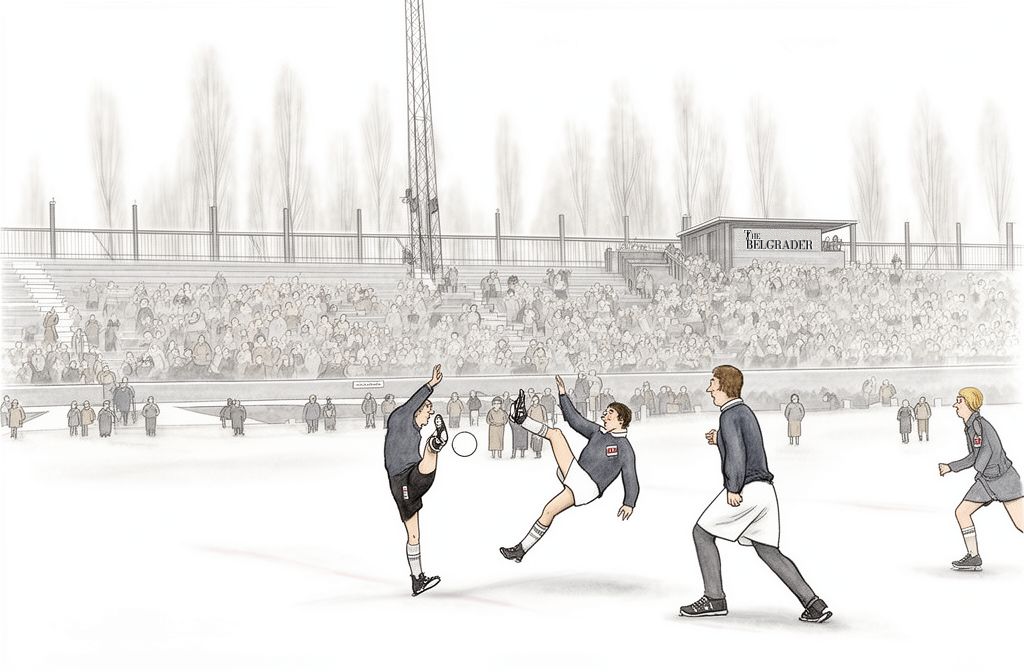
On 5 January 1947, the snow in Belgrade was falling all day. It was the first time Partizan and Crvena Zvezda played each other in a league match, and it arrived on a Sunday.
The stadium ‘20th October’ hosted the best teams this recovering city had to offer and, on a freezing day, only four thousand people gathered.
The pitch was cleared of snow but it kept falling and the players didn’t feel much of a difference. The temperature was nineteen degrees below zero, and the football behaved accordingly. It could’ve turned into stone, were it not for frozen boots to thaw it.
Both teams wore thick, long-sleeved shirts. They all appeared dark in the black-and-white newspaper reports – only Zvezda’s white shorts differentiated the two sides. But the players themselves discerned each other in their own ways.
Ljubiša Sekulić, Zvezda’s secretary at the time, remembered it this way. ‘Zvezda was founded first so all the best footballers from Belgrade played there. That’s why Partizan had to bring players from elsewhere. We weren’t close with them. We never called them Partizan, only they or neighbours.’
Partizan were the army club. The crest with the red star on their shirts carried the initials JA, for the Yugoslav Army, and their full name was the Central Headquarters of the Yugoslav Army ‘Partizan’. The stadium they played in was named after 20 October, the Liberation Day of 1944, and in the years that followed, a new one was planned on the same ground. That stadium, too, would be named by the army.
Before the season, Partizan toured the Soviet Union and Poland. The club drew on its connections with the army to bring players their way, and other clubs felt they were privileged.
Freezing in the stands, the journalists knew how the teams should play in such harsh conditions. They realised ‘the ball cannot be held for long’ and claimed none of the excessive combinations helped. For them, it was obvious – ‘get to the opposition’s goal as quickly as possible and shoot from any position.’
Partizan and Zvezda played exactly that way. Just twelve minutes in and Zvezda fans were clapping, their hands getting warmer in celebrations.
A corner kick leads to a crowded struggle. Zvezda forward Jovan Jezerkić shoots on goal and someone from Partizan’s defence clears the ball out. Zvezda players celebrate; Partizan players claim the ball didn’t cross the line. The goal is given; it’s 1–0.
Jezerkić scored Zvezda’s first-ever goal against Partizan. The teams had actually met once already, on Orthodox Easter the year before. The match ended 2-0 for Partizan but that was a friendly. Here, the points were on the line and Partizan had a perfect record to keep.
The army team had played ten league matches beforehand and won all of them. They had beaten teams from Skopje, Titograd, Sarajevo, Belgrade, Subotica, Zagreb, Rijeka, Split and Trieste. They scored thirty-one goals and conceded four.
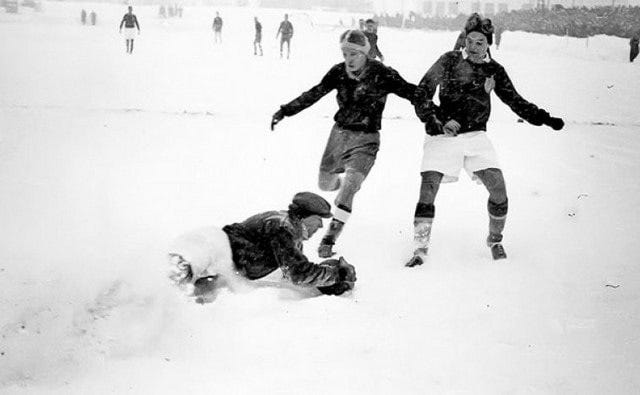
But Jezerkić now made that five. He wasn’t part of that first friendly in 1946, and later in 1947, he would join Partizan. He would become the first and one of two men who were to score in the derby for both clubs.
Before he got the chance to make the first of two switches—he would return to Zvezda in 1948 after struggling with Partizan’s military discipline—Jezerkić was not done with scoring in the snow.
Midway through the first half, inside-right Rajko Mitić and outside-left Andrija Šećerov combined and opened a narrow corridor through Partizan’s defence. Jezerkić slipped into it, shot from a tight angle, and the score was now 2–0.
His goalscoring afternoon made it a trying one for Partizan goalkeeper Franjo Glazer.
By then, Glazer was thirty-four. Former national team member, his best days were behind him but also his worst. His past, however, included a murder conviction – in 1936, Glazer played for BSK from Belgrade, when he pushed his teammate into the River Sava, and the player, not knowing how to swim, drowned.
Glazer didn’t seem to be enjoying his day against Zvezda. Early in the second half, Šećerov drove a shot that the goalkeeper pushed away, only for Jezerkić to be there and complete his hat-trick. Zvezda had a 3-0 lead.
Šećerov would not stay long enough to see many more of these matches. Within a year, on a trip to the Free Territory of Trieste to play Ponziana, he would not return to Yugoslavia. Aleksandar Aranđelović, who played beside him as an inside-left, did the same just months after this match. Rajko Mitić was said to have considered defecting but he did not go.
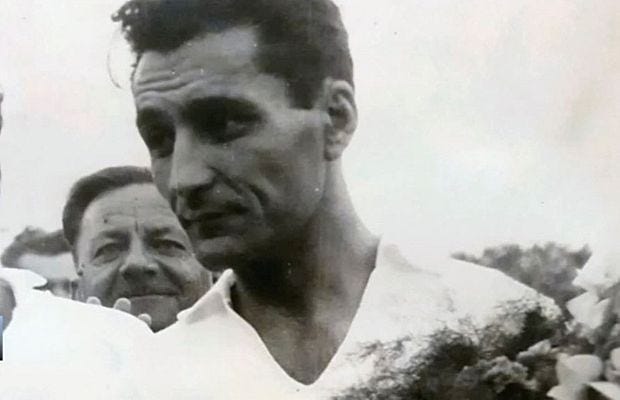
Mitić played well that day, as he often did. He became Zvezda’s first captain and remained one long enough to collect five league titles and four cups.
Once, years later, he ordered his closest friend, Branko Stanković, off the field during a match, raising the question of how much authority a captain ought to have. Mitić never left the club. At least not officially; he joined Partizan as a guest on their tour of the Soviet Union in 1946.
Zvezda’s stadium now carries Mitić's name.
A three-goal lead after fifty-four minutes did not settle the matter. Partizan continued to come forward, as teams do when the alternative would be to accept their first defeat.
Predrag Djajić, Zvezda’s left-half, occupied several minutes almost by himself. During Partizan’s attack, he headed the ball into his own net, reducing the margin. Shortly afterward, he took a free kick that restored it. Glazer reached for the shot and did not stop it – the reporters pointed to the snow, which was falling into the goalkeeper’s eyes. The score was 4–1.
Djajić was known as the first Zvezda player, emerging from the student movement that helped bring the club into existence only months after Belgrade was liberated.
That afternoon, he supplied the derby with its first own goal and its first free kick goal. When his teammate Mladen Kašanin followed with another mistake at the back that resulted in an own goal, Partizan found themselves involved again.
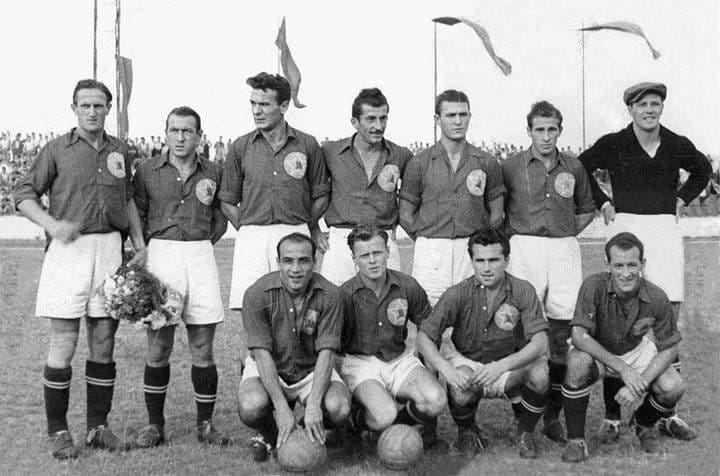
With less than ten minutes remaining, the score stood at 4–2, and three minutes later it did not. Another defensive error—this one by Branko Stanković—left Stjepan Bobek alone. Partizan forward brought the ball down on his chest, waited for it to fall, and struck it under the crossbar.
Bobek was eighteen when the war fractured Yugoslavia into occupation zones and new states. He briefly left Zagreb to go to Austria and play for Admira Wacker, and then returned home.
In 1944, with the end of the war approaching, he joined Građanski Zagreb, a pre-war club of some distinction. Márton Bukovi wanted him in his team, and that carried weight. During the later years of the war, Bobek also spent nights moving from place to place, avoiding conscription into the Ustaše.
By 1945, with the Independent State of Croatia having collapsed and a communist Yugoslavia established, Bobek had to go to Belgrade. He joined the army’s team and became one of its central figures.
Partizan continued to attack, Zvezda continued to defend. ‘Time passes either too quickly or too slowly,’ one report observed.
The final minutes stretched and then were gone. Zvezda held on, the score stood at 4–3, and Partizan lost a competitive game for the first time. They would, nevertheless, go on to get a rematch later that season and then win the title.
But this game was recorded as match number one. And the numbering continued. ◆
Also from The Belgrader:

Enjoyed this piece! I knew I recognized the Rajko Mitic name. What one often sees as listed as the Marakana is the stadium named after him, as well. On PES it's listed as the RM. Cheers.