

As Big as Chile
A Sunday afternoon in a Serbian village, a local football club, and a matter of scale

When you get to the village of Žabar near the town of Šabac, a certain kind of sadness kicks in.
It was a cold Sunday when I got there. The streets were wet from the rain, and empty of life. Not a stray dog passed by to sniff the visiting stranger.
There was a worn-out house by the winding road, wedged between nothing and nowhere. Its concrete walls were cracking – maybe from their old age and possibly from solitude. But the fresh look of the windows revealed it was not abandoned. The label across it indicated that a football club lived here.
FK Dobrava is written on it, their logo stamped too. And this is their bife - the club’s meeting point, office, coffee house, pub, or whatever they need it to be.
I peek through the pasted-over window and I see two flags on the opposite wall. They are both red, blue, and white: one is Serbian, and the other is Chilean. They are put together, their edges forming a handshake, and the sight smells of a warm friendship.
And in a way, this small football club, from a village of less than five hundred people, has made that friendship possible.
It was the Covid summer of 2020 when the boys and men of Žabar decided to form a football club. ‘There is nothing in this village. Nothing happens here, everything is slowly dying,’ Stevan Pantelić tells me.
He greets me by the bife and starts our walk to the local stadium. Stevan is twenty-nine when we speak, but his seriousness exudes a bigger number. He has short, sharp hair, and while he talks, two horizontal lines forming on his forehead add thoughtfulness to his words.
Stevan has a wife and two kids. Recently before we met, he finished building a house for his family, not far from the bife. He and his mates restarted the local football club to hang out but also to bring some life to their quiet village.
Žabar is south of the city of Šabac, the main town of the district of Mačva.
It is located in Western Serbia, on the southern edge of the Pannonian basin, where the shallow Pannonian Sea used to be. But that was millions of years ago.
These days, people are leaving it in search of better opportunities. Stevan, with his orderly short beard, is one of the guys that wants to stay in his hometown.
We get to the pitch where Dobrava is about to play their match. It’s a plain, somewhat bumpy field. The grass has the full depth of autumn colours, and the green is just one of many shades. The lines on the pitch have curves even on the straights.
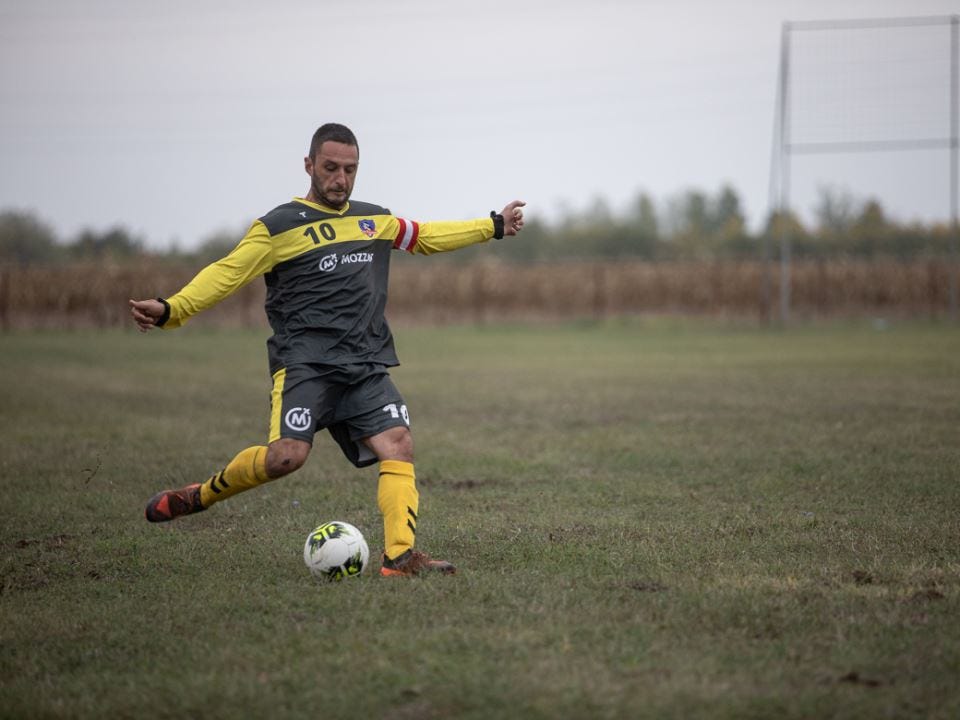
Five yards from the throw-in line, three men in their forties stand, their cigarette smoke mixing with breath vapor. Behind them, an old Volkswagen Golf is parked, headlights aimed at the pitch.
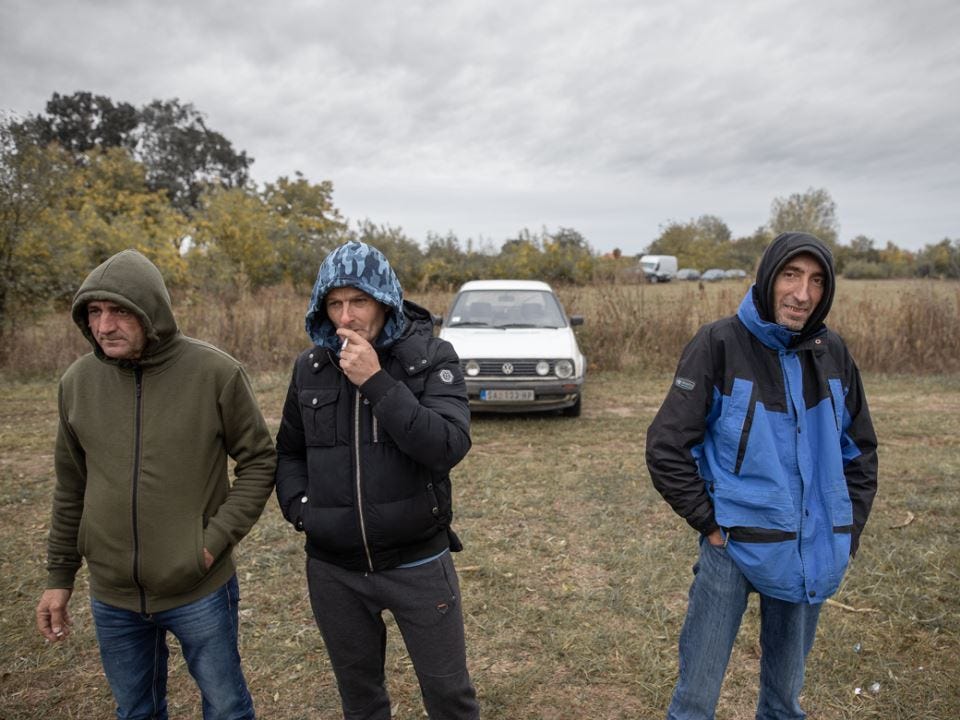
Across the pitch are the dugouts. Or rather, two benches locked in concrete blocks poured over grass, wrapped in metal boxes. The boxes have been rotting for a while but they shield players from windy afternoons like this one, and a sheet of tin on top of the construction keeps their heads dry.
Near the dugouts is another run-down house. The players and the referees use it for their dressing rooms. The body of the house is made of greying cinder blocks, and orderly clay tiles complete the roof, its orange becoming deeper when it rains.
Inside, the paint on the dressing rooms’ walls is spent but the flooring is impeccable. ‘A local company gave us tiles to renovate the dressing rooms ourselves’, I hear.
The central outer wall shows the club’s crest. It’s a blue shield with an indigenous man wearing a black band on his forehead. A red banner goes across his chest and usually, it says ‘Colo-Colo’. This one says ‘FK Dobrava’.

‘We took their crest for the characteristic individual on it. We always had sympathies for Colo-Colo,’ says Nemanja Radišić, a sort of a PR officer for the club.
The man on the emblem represents the Mapuche chieftain Colocolo who led the war against the Spanish Empire some four hundred and sixty years ago.
‘This club means a lot, especially to the young guys. When it all started, it was a euphoria that’s hard to describe. The games, the cheering and chanting. This place now has something to talk about. You know - drinking coffee at your neighbour’s place, chatting about what happened at the game.’
But their logo is why Dobrava need a PR officer in the first place.
Someone in Chile found out about their club on Instagram and they became a sensation. The fans of the greatest Chilean club immediately started following them. Sixteen thousand of them, in fact.
‘We never expected that,’ Nemanja exclaims, still visibly surprised about the previous year. ‘When it all broke out in Chile, I was giving so many interviews I couldn’t count them.’
Their Instagram profile became the talking point. Nemanja and his mates posted only in Spanish. They introduced each team member individually, like they were digital Panini stickers. And the comments sections were filled with remarks from the other end of the world.
The chubby right midfielder Ivan Pantelić was likened to the Chilean navy ship Cazador, whose sinking in 1856 resulted in the greatest single-incident maritime loss of life in the history of Chile.
Left-back Nemanja Isaković—with his beardless, sunken cheeks but sharp, blue eyes—was adored for having ‘a face that could break your legs.’ The club wrote they signed him because he was ‘in great form for drinking beer.’
Colo-Colo fans found their new heroes, regular blokes with names hard on their tongues.
The fun at FK Dobrava was magnified by great results in their first-ever season. The wins were numerous, and two of their proudest moments included winning the league and drinking eleven crates of beer after a friendly. Each crate holds twenty bottles.
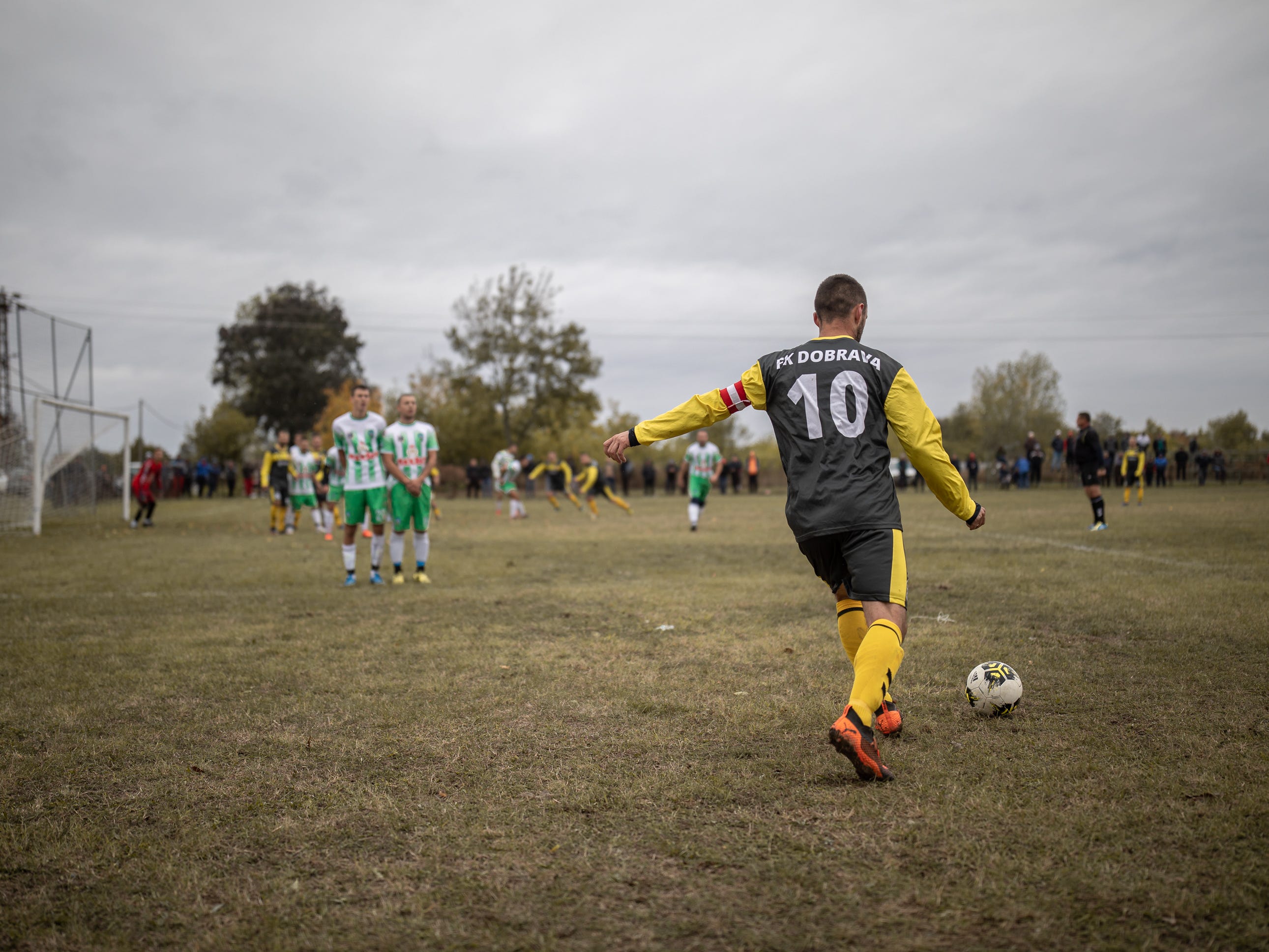
Now they were in a higher division, in the sixth tier. The wins are not as common as they used to be but their match against Sipurske Livade started well when captain Stevan scored after seven minutes of play.
The attendance is not what it usually is. A few dozen fans are celebrating the goal, some perched over the fence, others clapping from the wooden stands. All of them are cold. In warmer weather, people from other villages stop by and a crowd of three hundred or more gathers.
By half-time, the visitors make a turnaround to lead 2-1. At the centre of it was Dobrava’s plump goalkeeper, nicknamed Pekar (the baker). One of his misjudgements was as big as Chile.
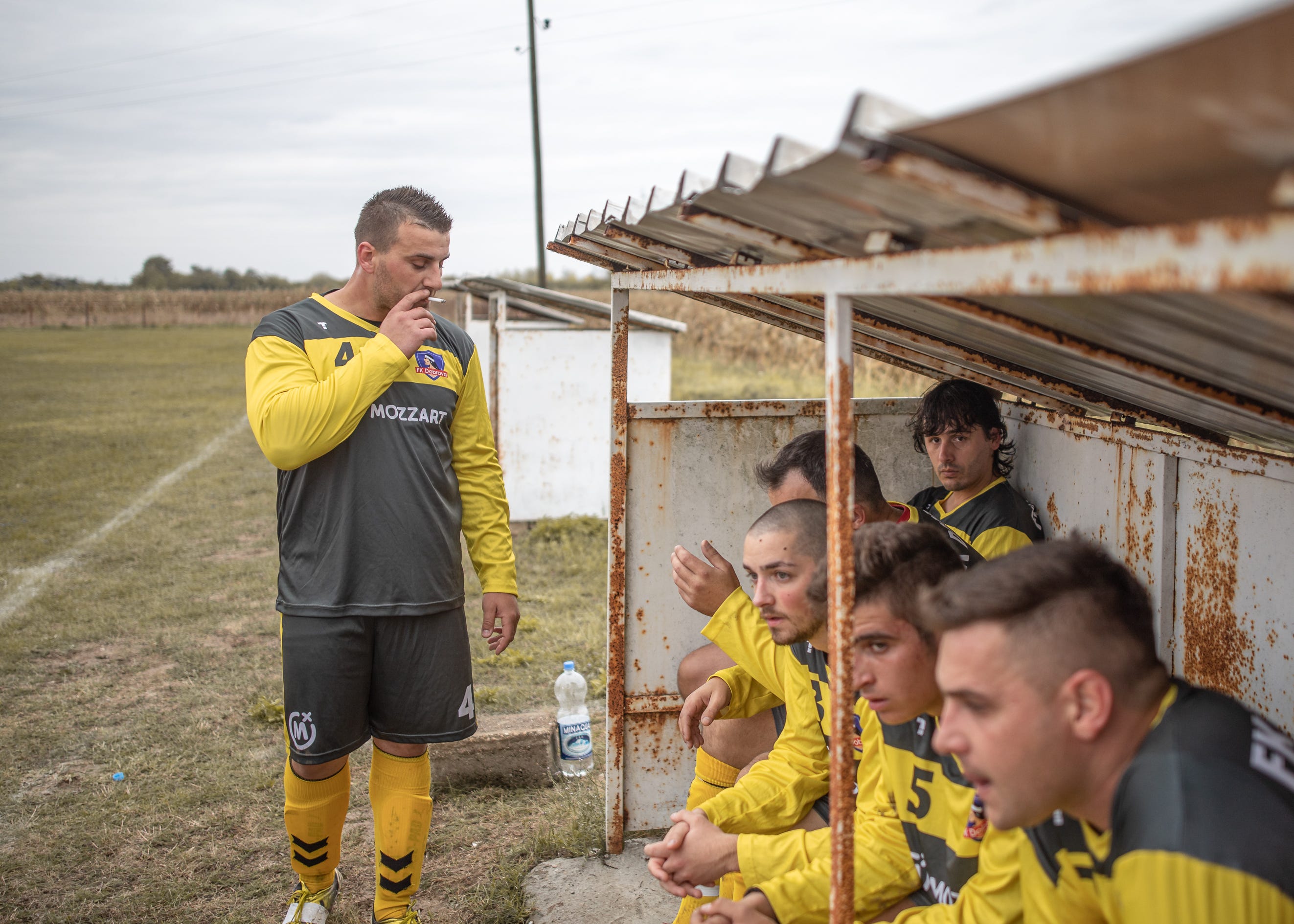
The half-time break was noticeably shorter than the usual fifteen minutes, and the hosts save time by gathering in the dugout. The wind is strong but the dugout is as warm as the dressing room. And some of the players need a smoke or two to cool down, anyway.
Their faces show they are puzzled, annoyed and angry all at once. Couple of them have blank stares, and one of the guys is throwing his arms because ‘they are beating us here and not getting any yellow cards.’
Dobrava’s second-half performance has more heart in it. They attack, they run harder, and their cheeks get redder. They show one-twos that bring slight gasps from the onlookers.
There are harsh fouls too. After one such tackle, a scuffle breaks out in the centre of the pitch but it then keeps drifting to the edge of the penalty area. The referee struggles – everyone seems to know him and that’s how they argue with him. The fans have humorous quips for his assistant ready at all times.
The away team, playing in green-and-white vertical stripes, had one of their substitutes come on wearing horizontal ones. It felt like a Celtic defender came on for a Real Betis midfielder. No one cared.
Players are nervous, both sides, but Dobrava run out of time to score the goal they needed. The match ends with a 3-1 loss, their first defeat at home in the past year. They will feel it on Monday when they go back to work.
‘We can’t send every ball to Stevan.’
‘You have to run more, you stay up there and nothing happens.’
‘We have to put the ball down and play more.’
Deflated, the players are ready for bife. The tradition of sitting down post-match (for what is colloquially known as the third-half) over a barbecue and drinks is what the whole day leads to. Tired and aching from fierce fouls, they all come together underneath the flags of Serbia and Chile.
The referee is also here, feeling at home with a beer in his hand, and some of the boys are getting the chopped wood into the furnace. Stevan says his ribs hurt when he breathes in, from a foul he got. The murmur is constant, as if everyone is talking at everyone.
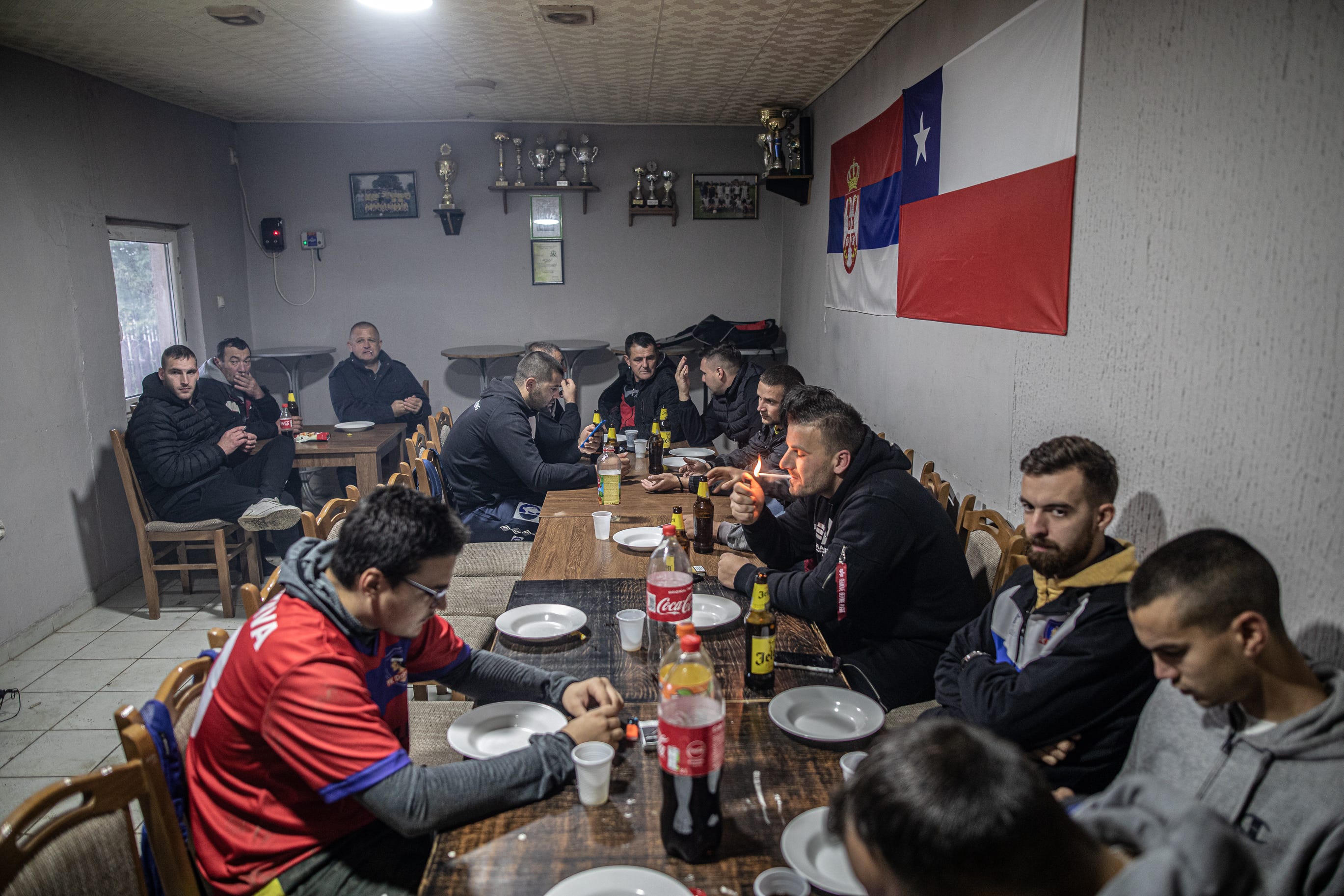
The team’s coach Vladimir Djurdjević—nicknamed El Profe by Dobrava’s Chilean fans—has an innocent smile and fingers yellow from his smoking habit. He says the club were contacted even by the mighty Colo-Colo. Nemanja, in his PR role, has his phone full of WhatsApp conversations, some of them with Colo-Colo’s organised fan groups, barras bravas.
‘The management of Colo-Colo has expressed interest to organise a fundraiser in Chile so we can go there and be their guests once this thing with Covid is over. Two or three of their biggest fan groups also supported this,’ Nemanja reveals.
The guys formed the club to share their love for football and now, this hobby grew into a dream no one would’ve dared to imagine.
‘We want to go to Chile but not just for the trip. Think about the generations after us! The stories would be told and retold, how some guys from their barns in Serbia sat on a plane and went to Chile. That’s what we live for!’
The players didn’t know it then but their hopes never got them on that plane.
Euphoria dissipated and, last season, they won three of their twenty-six matches. They finished bottom and were to be relegated to the lowest division, the one they won years ago.
But in the summer of 2025, they ran out of money needed to keep the club going. After five years, FK Dobrava stopped competing and the village lost the best thing that happened to it this decade.
These days in Žabar, the pitch is still cut. The lines are faint and crooked, and no one argues about them. The weeks no longer build toward anything - Sunday arrives, and then passes.
And then a certain kind of sadness kicks in. ◆
Also from The Belgrader:



Fantastic writing. So happy to have found your work!
‘We want to go to Chile but not just for the trip. Think about the generations after us! The stories would be told and retold, how some guys from their barns in Serbia sat on a plane and went to Chile. That’s what we live for!’
I loved this quote.
But also so much of this piece had a familiar resonance to it. Having grown up outside a small Kentucky town, this desire to find some meaning, some ritual to keep things going, the push to leave the pull to stay, finding connections across the globe over some shared thing...so much feeling here.